Dust-Off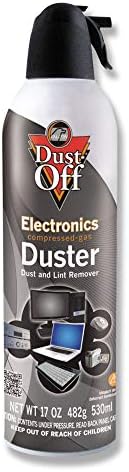
Big cans and cases
Jumbo Duster, 17 oz
No ratings yet
$23.99$1.41 an ounce of gas
A single large can built for cleaning deep computer towers, thick fan grilles, and hobby benches with heavy dust.
Shake a can and you can hear it. Most of what you are holding is liquid, sitting in the bottom of the tin with a layer of gas above it. The gas is what the can sprays, and the liquid is the reservoir that keeps making more of it as the pressure drops.
That arrangement only holds while the can is the right way up. Turn it and the liquid moves, and the can has no way of knowing that you did not mean it to.
Inside the can a thin tube runs from the valve down toward the base. Held upright, the mouth of that tube sits in the gas layer at the top, so gas is what travels up it and out of the nozzle.
Tip the can past roughly the angle where the base stops facing the floor and that mouth goes under the liquid. From then on the tube carries liquid, and the trigger you are pressing is doing something quite different from what it did a second ago.
Liquid leaving a nozzle at room pressure boils on the spot, and boiling takes heat from whatever it lands on. It is very cold, colder than anything else likely to touch a circuit board or a lens that afternoon, and it arrives wet.
On a keyboard that means a damp patch and a frost ring. On coated glass it means a sudden temperature change across a small area. Neither is dramatic, and neither is something you want on purpose.
The fix is almost always to turn the work instead of the tool. Stand a keyboard on its long edge and clean down the rows. Lay a tower on its side on a bench and walk around it. Take the shelf off the wall rather than reaching up under it with a tilted tin.
When the gear genuinely cannot move, the straw does the reaching. A long straw held at an angle off an upright can gets into places your wrist cannot follow, which is exactly the problem it was made for.
Under a desk, into a wall vent, along the underside of a shelf, and inside a car footwell. All four have the same shape: the target is above or behind you, and the natural way to point at it turns the can over.
If you notice the stream go quiet and wet, stop. Set the can down upright for a minute and let it settle before you go again. Nothing is damaged, but carrying on will put liquid where you did not want it.