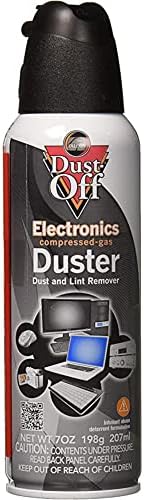
Dust-Off
Big cans and cases
Professional Duster, 12 oz 12-pack
★★★★☆4.2 from 783 ratings
$60.90$0.42 an ounce of gas
A full case of large cans for running through rows of desktop towers, shop workbenches, and vents without running out mid floor.
The habit of calling these cans air is old and hard to shift, but there is no air in one. What is in there is a single gas that has been squeezed until it turned into a liquid and stayed that way under its own pressure.
That distinction is not pedantry. Almost everything odd about how a duster behaves follows from it. A tank of squeezed atmosphere holds no liquid at all, empties in a smooth falling hiss and never goes cold in your hand.
Open the valve and the pressure at the top of the can drops slightly. The liquid underneath responds the way any liquid responds to a drop in pressure above it: some of it boils, and the gas it produces restores the pressure.
This is why the stream holds steady rather than trailing off like a balloon. As long as there is liquid left and it is warm enough to boil, the can keeps topping itself back up.
Boiling costs energy, and the liquid takes it from the nearest source, which is the tin around it and the hand holding the tin. Spray for long enough and the can goes properly cold to hold.
Cold liquid boils more slowly, so the pressure inside falls and the stream softens. That is the whole story of the fading duster, and the cure is to stop for a couple of minutes and let the can come back to room temperature. Warming it any faster than that is a bad idea for reasons the label spells out.
A can is sold by weight rather than by how much space the contents occupy, which is why the shelves here read in ounces. A 10 oz can holds ten ounces of the stuff, and what that turns into as gas is a much larger number that nobody finds useful.
It is also why a nearly empty can still feels like a can. The tin, the valve and the trigger have their own weight, so the useful contents run out well before the thing in your hand starts feeling light. Judge it by the spray, not by the heft.
Much of the line runs on the gas the label prints as 152a. Some cans are filled with a different gas for rooms where that is the requirement, and the can itself always says which one it is.
Read the tin rather than assuming from the shelf. Two cans that look the same size and carry the same brand can be different fills, and the label is the only place that difference is written down.